RouterOS License Comparison: Level 4 vs Level 5 vs Level 6
A detailed, side-by-side view of the three RouterOS license levels we sell. If you’re still unsure which one fits your hardware, read the Buying Guide or contact our team before ordering.
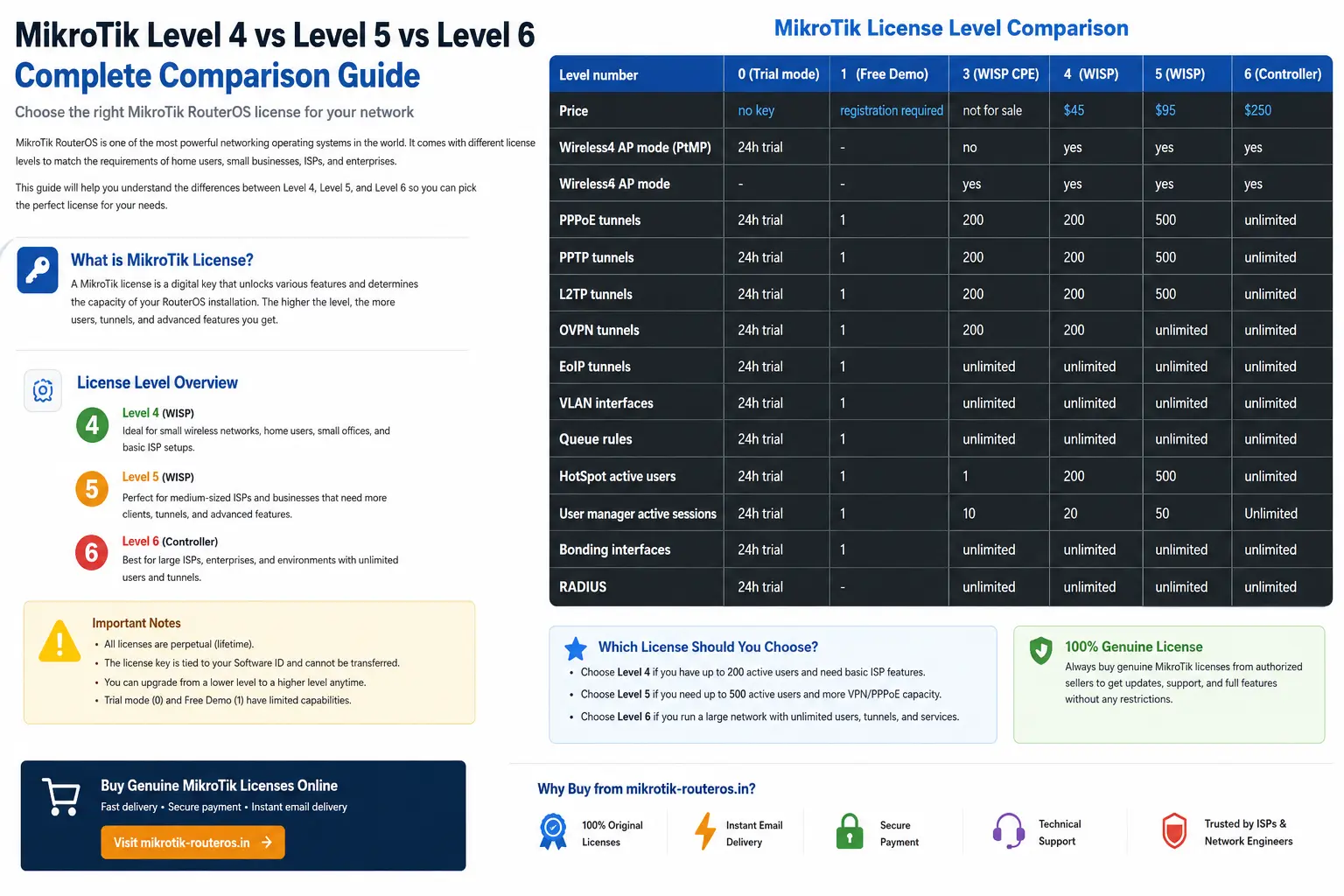
| Feature | Level 4 | Level 5 | Level 6 |
|---|---|---|---|
| Wireless interface (AP / client) | Yes (single) | Yes | Yes, unlimited |
| PPPoE tunnels | 200 | 500 | Unlimited |
| PPTP tunnels | 200 | 500 | Unlimited |
| L2TP tunnels | 200 | 500 | Unlimited |
| OVPN tunnels | 200 | 500 | Unlimited |
| EoIP tunnels | Unlimited | Unlimited | Unlimited |
| HotSpot active users | 200 | 500 | Unlimited |
| User Manager sessions | 20 | 50 | Unlimited |
| VLAN interfaces | Unlimited | Unlimited | Unlimited |
| Queue rules | Unlimited | Unlimited | Unlimited |
| RADIUS authentication | ✓ | ✓ | ✓ |
| Routing protocols | RIP, OSPF, BGP, MPLS | RIP, OSPF, BGP, MPLS | RIP, OSPF, BGP, MPLS |
| License validity | Lifetime — perpetual, never expires, free software updates forever | ||
| Best for | Small offices, branch networks, starter WISPs (up to 200 users) | Growing ISPs / WISPs (200–500 users) | Large ISPs, enterprises, data centres |
| Buy Level 4 | Buy Level 5 | Buy Level 6 | |
The license key is tied permanently to your Software ID and cannot be transferred to different hardware. You can move to a higher license level at any time by purchasing that level separately — see our Software ID Guide for how Manual License Verification works.
Who Should Choose Each Level
Practical use cases for each RouterOS license tier.
Level 4
Choose Level 4 if you have up to 200 active users and need core ISP features on a single access point or branch link — typical for small offices and starter WISPs.
Level 5
Choose Level 5 if you need up to 500 active users and more VPN/PPPoE capacity for a growing wireless network — typical for expanding ISPs and WISPs.
Level 6
Choose Level 6 if you run a large ISP or enterprise network with unlimited users, tunnels, and services — typical for core routers and data centres.
Deploying on a Virtual Machine? CHR Is Coming Soon
Cloud Hosted Router (CHR) is RouterOS built for VMware, Proxmox, Hyper-V, VirtualBox, KVM, AWS, Azure and other cloud platforms, licensed by throughput (Free, P1, P10, P-Unlimited) rather than by device role. CHR licensing is coming soon to this store — see the CHR page for details.
Can I Upgrade Between Levels Later?
Yes. MikroTik allows moving from a lower license level to a higher one at any time — this means purchasing that higher level’s license against the same Software ID, rather than an in-place “upgrade” of your existing key. Contact us and we’ll guide you through the process.
Frequently Asked Questions
Are the tunnel and user limits per device or per license?
Does a higher level include everything a lower level has?
What if my router’s hardware can’t handle Level 6 traffic anyway?
Ready to Buy?
Head to the Products Hub, or read the Buying Guide for what happens after checkout.